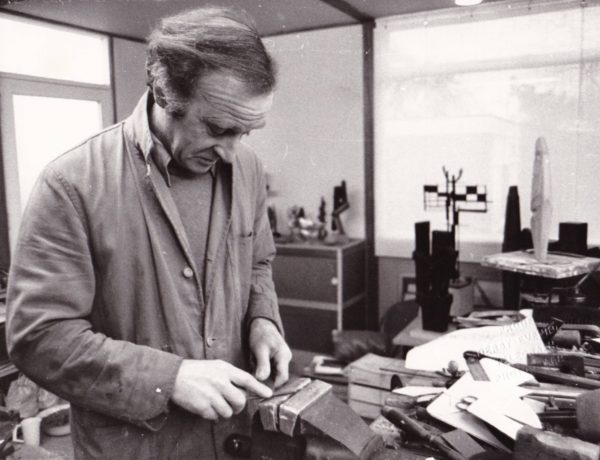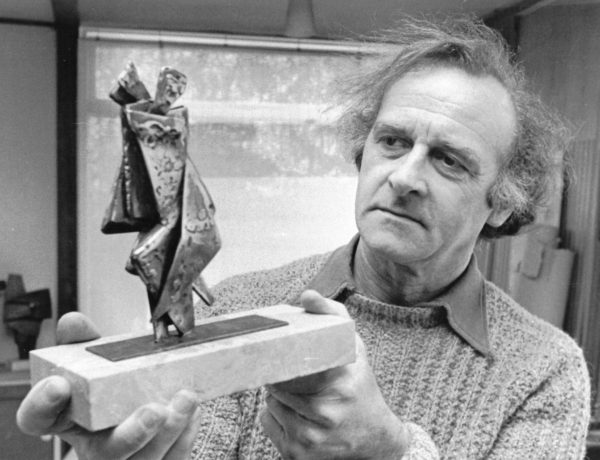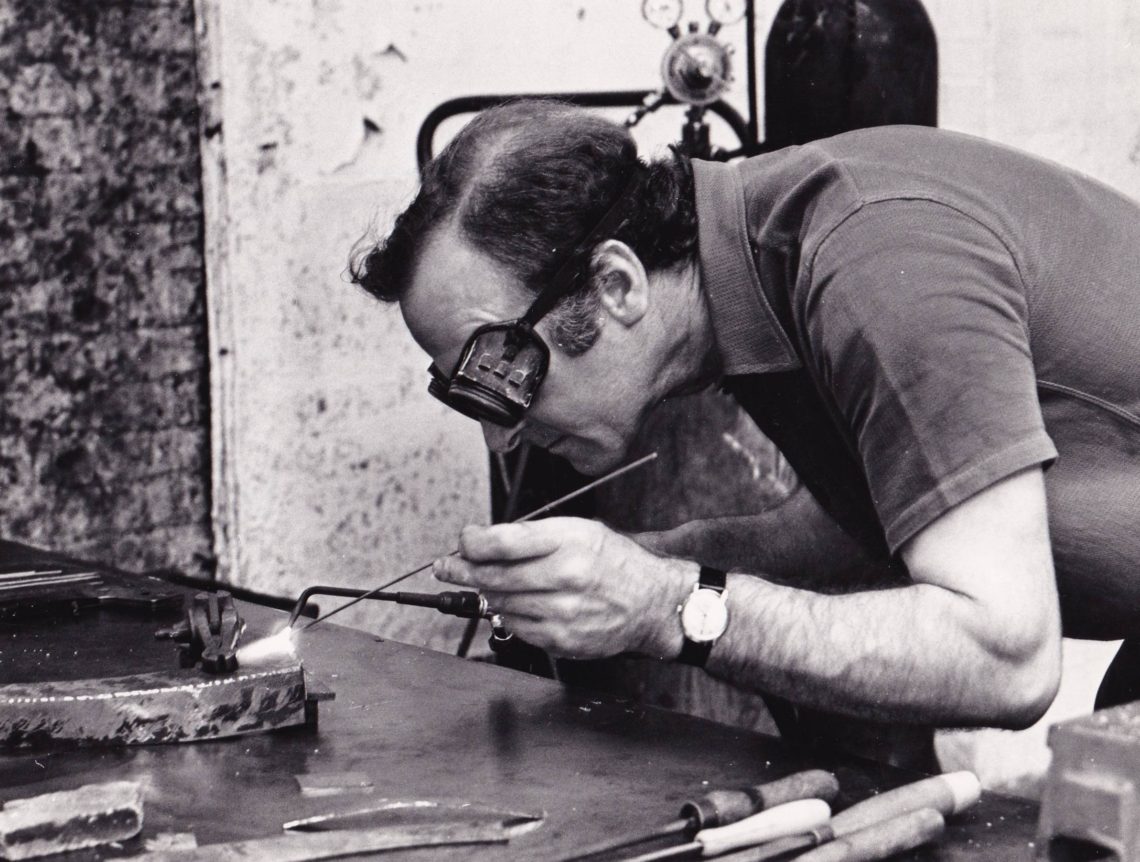
Ronald Pope (1920-1997) was a sculptor who deliberately preserved his privacy and divorced himself from the public world of art, even though many of his sculptures were commissioned for public display. In his poems, he wrote:
The secret artist works alone
Ronald Pope
Driven by an inner urge
To create again
A special version of the truth
Devoid of material gain
Satisfying universal need”1
He was a sculptor of the ‘Modernist’ school, alongside contemporaries such as Constantin Bracusi, Henry Moore and Barbara Hepworth, and is listed in the Henry Moore Institute archive. He was unconventional in his approach to materials, and was always looking for new and simplified forms of representation. Above all Pope was fascinated with the theme of human unity, exploring its meaning through diverse subjects such as families, crowds and natural landforms. His art reflects some of the anxiety, as well as the hopefulness of the post-war period in which he worked.
He created over 400 unique and loved sculptures, with large collections at Derby Museums, and the Djanogly Gallery, University of Nottingham. These sculptures are scattered around Derbyshire, Nottinghamshire, and Leicestershire. Further afield he has major work in Hertford2, Sheffield, and many other locations, including a large collection at Watford Museum.
After leaving school Pope attended Art School in Derby, but began his working career in 1938, as an engineer apprentice with Rolls Royce, Derby. He was a good engineer, but art was in his soul, and at lunchtimes he would borrow a room and paint in oils. He had no expectation that this would lead to anywhere other than an interesting hobby, until a former teacher and friend suggested he try for the Slade School of Fine Art, London. In 1945 he applied, and was immediately accepted.
While studying at the Slade, Pope lived with his wife, Joan, in Ticknall, Derbyshire, renting a former gamekeeper’s cottage called Knowle Hill. It was here that Pope began his career as a sculptor, and where their two children were born. The cottage was basic, having no electricity, mains water or sewage and no bathroom, Pope describing bath time as ‘Monday left arm, Tuesday right arm’, and so on.
The cottage itself has an interesting history, having been associated with the ‘Legend of the Severed Hand’3). It was built around 1766 by the Burdett family of Foremark, but fell into disrepair after the Popes left in 1957. Fortunately, the Landmark Trust came to the rescue, and restored it for use as a holiday let.
It was at Knowle Hill that Pope began to establish himself as a sculptor. However, recognition came at a price which Pope was not comfortable to pay. The more the quality of his work became recognised, the more he retreated from the public gaze, and the more he became increasingly frustrated with the commercialism he would need to embrace to deal with it. He had several large exhibitions during this time, but he was uneasy with the concurrent demands on him, and intrusion into his private life. His rejection of public acclaim was not a by-product of introversion. Far from it. Pope was a man with a clear mind and determined nature; but he was, at heart, a philosopher, a ‘truth-seeker’, who believed deeply that ‘True art is a loving art’ (Martin Buber4), and that everything he created was ‘sufficient to itself’5. He studied Philosophy, in particular the works of Buber, and throughout his life he tried to explore the deeper meanings of love and life, and to convey his thoughts to the wider world through his sculpture. His ideals are also expressed in his poetry, in which he wrote:
One makes a space within oneself
Ronald Pope
Where ideas and thoughts
Mature and grow –
To be brought to fruition
By the creative process
Untrammelled by external fashion.6
These ideals are also expressed in much of his sculpture. On the ground floor of the Cathedral Cafe, Derby is a sculpture in elm called ‘The Family’, depicting two parents and a child. Look closely at the attitude of the figures – one parent embracing the other, who is then embracing the child, who is, in turn, in an attitude of prayer. All three are joined by bindings. The effect creates the impression of a family with a strong bond, and to inspire spiritual reflection on the nature of their relationship. This was without doubt the real core of Pope’s life; his belief in the ‘oneness’ of the family, and indeed, humanity. His murals at St Simon and St Jude Primary School (Earl Shilton, Leicestershire) and at Wigston Academy (Wigston Magna, Leicestershire) are typical depictions of this ideal, using both figurative and abstract representations of the adult/child relationship – the essence of love. Many schools have given their sculpture distinction, as a logo, or by placing it in a prominent position – Derby Moor Academy has redesigned its front entrance around its Pope sculpture.
His inspiration appears to have come from home and the sense of family. There are several sculptures, in stone, wood and metal, with names such as ‘Mother and Child’, ‘Child with Flower’, ‘Family Group’, ‘Mother and Child with Bird’; young children and the importance of the growth of relationships, feature in his work.
He was prolific in his sculpting output, and also sketched dozens (if not hundreds) of drawings for works he had no time to complete. All his sculptures are unique, and there are no copies.
Initially Pope concentrated on relatively small sculptures, but as his reputation grew he was offered larger, more complex commissions, including the stone sculpture ‘Duo’ for Lady Paget at Kings Newton Hall. The statue was eventually moved from Kings Newton Hall to Bishop Lonsdale College, Derby, and is now on display at the Ashbourne Road site of Derby University. Interestingly the Pope sculpture on display at the University vividly show the range and versatility of his imagination – a few feet away from ‘Duo’ are three abstract sculptures by Pope, one in aluminium and two in bronze. The former captured the interest of the Henry Moore Institute, as representative of Pope’s work, and the maquette is now in its collection of works of Modern Sculptors.
By the end of the 1950s, Ronald and Joan Pope were able to buy a plot of land and build their own home, Blue Orchard, with its own studio, in Melbourne, Derbyshire. Pope’s versatility with materials and the range of his imagination blossomed at Blue Orchard, for by now he was working in stone, steel, copper, bronze and wood, producing sculptures large and small, for commissions from private collectors to Sir Basil Spence (Church of St Catherine of Siena, Sheffield).
Throughout his life, he struggled to reconcile his passion for peace, compassion and understanding in a world he saw as mechanistic, aggressive and driven by ambition, and his sculpture, at times, portrays this conflict. The crucifix sculptures at churches St Michael with St Mary’s (Melbourne, Derbyshire), St John’s (Long Eaton, Nottinghamshire) and Grangewood Methodist Church, (Wollaton, Nottingham), are indicative of Pope’s mind. Two of these sculptures, each in the form of a crucifix, convey this conflict by challenging convention – by expressing discord within the guise of a crucifix, but effectively rejecting conflict, by conveying the Christian message of peace. The third is less severe, but nevertheless makes a similar statement, by its challenge to custom – by its stark outlines it provokes uncertainty, but by its similarity to the cross of St George, it soothes the spirit. The Very Reverend R.A. Beddoes, Provost of Derby (1953-1980) wrote ”…the resolution of apparent contradictions (in life) is attempted – almost tenderly in his paintings and drawings, tautly in his sculpture”7.
It was during his time at Melbourne that he began to explore the Peak District in Derbyshire, with his wife, Joan. They would travel miles together on the trails, giving him the opportunity to investigate, and help protect Neolithic sites – he was particularly critical of plans to adapt the site of Minninglow (off the High Peak Trail). His main purpose, however, was inspiration. He was enthused by rock formations on cliff faces, such as Curbar Edge, taking dozens of 35mm slides to use as the basis for sculpture. It was during moments such as these that Joan’s natural tolerance and understanding must have came to the fore, as she waited patiently while her husband trudged across heath and moor to find just the right angle for his photographs. Her patience was rewarded when many of these images were translated into drawings, going through many stages before emerging as final designs for sculpture.
Ronald Pope was an extremely resourceful sculptor. For instance, he created the ‘Crowd’ series, the inspiration for which came from his visits to a shopping centre in Derby – he was enthralled by the visual impact of the rhythmical movement of groups of people. He created a number of related sculptures, mainly in copper and bronze – the ‘Musician’ series, the ‘Duo’ series, single figures, pairs of figures.
Although predominantly known as a sculptor, Pope also painted in watercolours. He loved painting and drawing, and in later life returned to it at the expense of his sculpture. But this was no loss, for they challenge his sculpture for the spotlight – his paintings are soft and gentle, described by enthusiasts as atmospheric, his drawings and sketches expressive.
It is quite probable that during his lifetime Ronald Pope would not have approved of a published account of his life and work – he would have preferred that his sculpture speaks for itself. But it is now imperative that he is brought more into view because public sculpture is being destroyed, including many Pope sculptures (see ‘Lost Heritage).
In February 2020 Derby Museums celebrated the reopening of the Silk Mill (in Derby) as a ‘Museum of Making’, included an exhibition of Pope’s work at the Museum. Sadly, Covid closed the exhibition early, but hopefully another will follow.
Footnotes
- Pope Ronald, ‘Ronald Pope Poems’, (Estate of Ronald Pope, 2000), p.25. Ronald Pope wrote poems throughout his adult life, intending to publish them. But his desire for privacy dissuaded him. His poems were collated in book form by his family after his death, but have not been published. [↩]
- Sculpture – ‘The Five Bishops’. Commemorating the 13th Centenary of the first Synod of the English Christian Church. Pope was awarded the commission following a national competition. [↩]
- Howard Usher, Knowle Hill Ticknall, (The Ticknall Preservation & Historical Society, 1993 [↩]
- Buber, Martin, Pointing the way: Collected essays, (Harper & Row, 1955 [↩]
- Thomas H Johnson, ‘Poem 862 – Light is Sufficient to itself’, in The Poems of Emily Dickinson ( Belknap Press of Harvard U P (1957) [↩]
- Pope R. op. cit. p24. [↩]
- Ronald Beddoes, ‘Ronald Pope, King’s Lynn Festival 1970’, Exhibition of Sculpture, Pastels and Drawings. (1970). [↩]