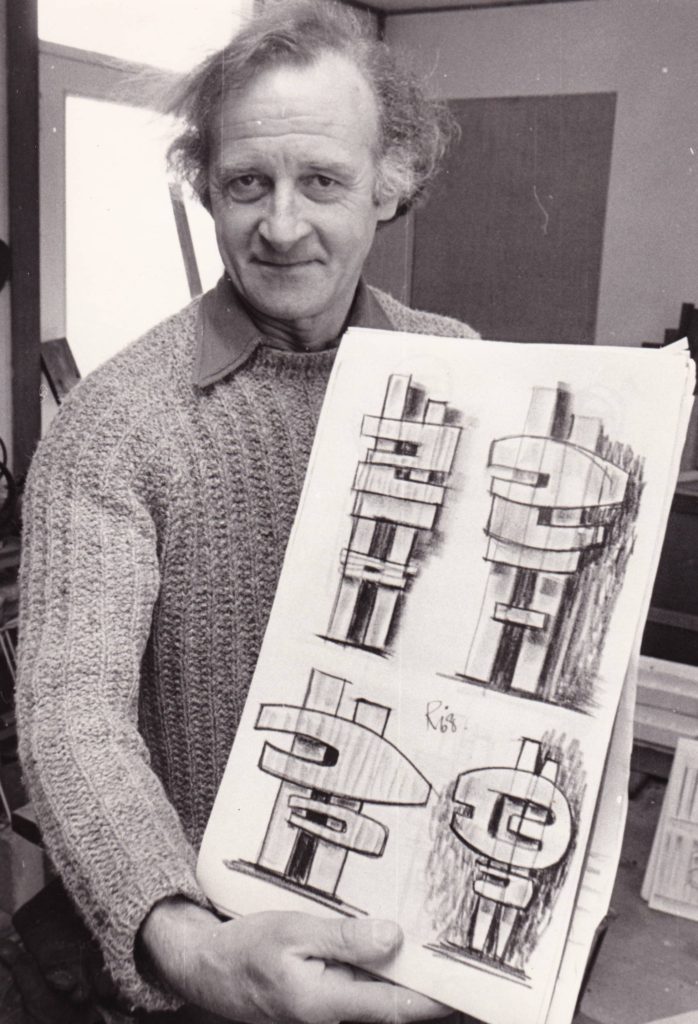
Ronald Pope (1920-1997) was a sculptor and artist of the modernist school. While his work shows the influence of his contemporaries at the Slade School of Fine Art, London in the mid 1940s, it is nonetheless unmistakably ‘Pope’, his own individual style and interpretative form.
He created high quality sculpture in stone, metal, wood and ceramic, in various forms. Much of his artwork mirrors his sculpture, but has a form of its own. It is simple, often monochrome, sometimes pastel coloured, but in spite of its apparently effortless form it conveys the complexity of human interaction and movement.
Pope’s deepest influence was his belief that a harmonious bond can exist between all people, and many of his sculptures (the ‘Duo’ series, several wall sculptures, and even his abstract work) succeed in projecting this ideal. He was also influenced by the shapes and forms of the landscape of the Derbyshire Peak District, where he loved to walk and roam. From simple drawings of rock formations he created powerful abstract sculpture, while retaining elements of the origin of his idea. However, his imagination and sources of influence were wider than this. His ‘Crowd’ series was born from his observations of people in a shopping centre, his ‘Musicians’ from his love of orchestral music, to name but two variations. These eclectic influences combined to create distinctive sculpture in both abstract and representative form.
Pope’s sculptural work covers four decades, the 1940s to the 1990s, and this website has been organised to reflect his changing styles over this period, but this chronology does not rigidly follow his ideas as they developed. It is, however, a useful indicator of how his mind was not locked into a pattern, of how he experimented with a new idea, but no doubt Pope would not recognise such phases in this way. To him, they would be all one phase, as one style drifted into the development of another. There are hundreds of sketches of possible sculptures showing this drift, and also his amazing imagination. He had the opportunity to convert only a few of these drawings to sculpture – even so, he was a prolific sculptor, creating over 500 sculptures in his career.
He believed his work should speak for itself, isolating himself as much as possible from the world of mainstream art. He had successful exhibitions in the Midlands, and later in his career in London, but his lack of interest in the culture of self promotion within mainstream art, and his relative isolation in Derbyshire, meant that he did not fall within the public gaze. Nevertheless, Pope’s work can be found in dozens of locations across the Midlands – schools, churches, public and private buildings – and collections are held by Derby Museums, Watford Museum and the Djanogly Gallery (University of Nottingham), and the University of Derby. The Henry Moore Institute has a Ronald Pope sculpture in its collection.
Our main purpose is to preserve his work for future generations, and allow everyone who is interested in art to enjoy his gift.