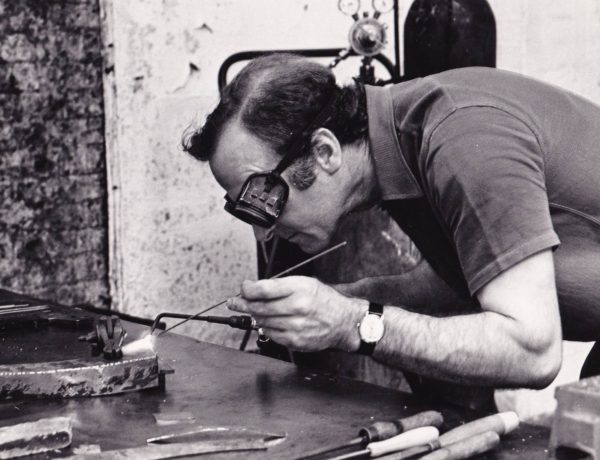
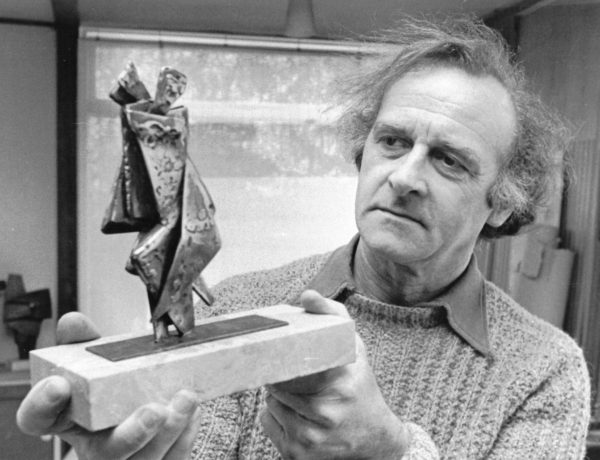
The secret artist works alone
Ronald Pope
Driven by an inner urge
To create again
A special version of the truth
Devoid of material gain
Satisfying universal need.
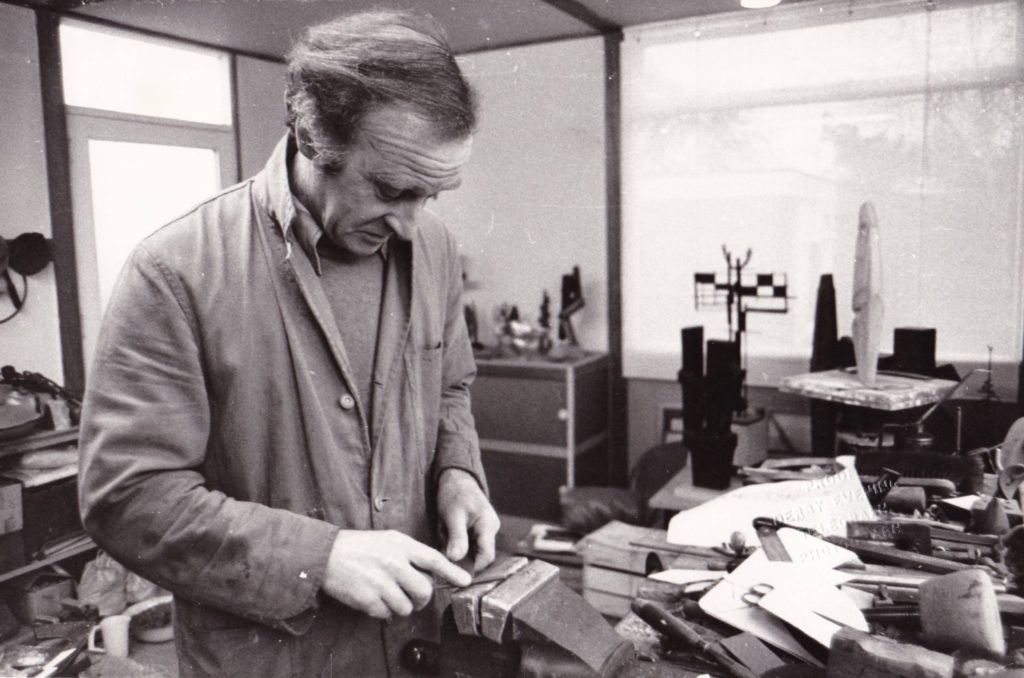
Pope is considered to be a sculptor of the ‘Modernist’ school – the Henry Moore Institute has placed one of his works in the sculpture collection of Leeds Museums and Galleries – but he rejected such descriptive conventions. His ambition was to express his values and ideals through his sculpture, believing that the sculptor has no need of the trammels of elaborate labels. He had faith in the power of his sculpture to send its own message to the beholder, that everything he created was ‘sufficient to itself’1).
It was at Knowle Hill, Ticknall, Derbyshire, that Pope began to establish himself as a sculptor. He and his wife, Joan rented the secluded former gamekeeper’s cottage probably for economic reasons, while he studied at the Slade, as much as aesthetic. However, the seclusion at Knowle Hill suited his philosophic nature, away from the influences and distractions of London.
In spite of his wish for isolation, Pope recognised the need to show his work to a public audience, and with some reluctance organised several exhibitions. Almost from the beginning of his career his work was in demand, but recognition came at a price that Pope was not comfortable to pay. He did not enjoy the intrusion into his private life, and was not at ease with the need to embrace commercialism to promote his work. He became increasingly frustrated with its increasing influence over artists and sculptors – believing deeply that ‘True art is a loving art’ (Martin Buber) 2).
His wish for seclusion was not a by-product of an introverted nature. Far from it. Pope was a man with a determination to live life, not as preferred by critics of his work, or as might be needed to promote his work, but by his own values and ideals. Disadvantaged he may have been by his isolation, Pope nonetheless followed a clear path. He was, at heart, a philosopher. He studied Philosophy, in particular the works of Buber, and throughout his life he tried to understand the deeper meaning of love and life, and to convey his thoughts to the wider world through his sculpture.
His feelings are expressed in his poetry, in which he wrote:
One makes a space within oneself
Pope, Ronald. op. cit. p24.
Where ideas and thoughts
Mature and grow –
To be brought to fruition
By the creative process
Untrammelled by external fashion.
Inspiration for many of his sculptures came from Pope’s love of home and family. Several sculptures, in stone, wood and metal, have names such as ‘Mother and Child’, ‘Child with Flower’, ‘Family Group’, ‘Mother and Child with Bird’; young children, and the importance of the growth of relationships within families, feature heavily in his work.
On the ground floor of the Cathedral Cafe, Derby is a sculpture in elm called ‘The Family’, depicting two parents and a child – one parent embracing the other, who is then embracing the child, who is, in turn, in an attitude of prayer. All three are joined by bindings. The effect creates the impression of a family with a strong bond, and inspires spiritual reflection on the nature and depth of their relationship. This was without doubt the real core of Pope’s life; his belief in the oneness of the family, and indeed, humanity.
His murals at St Simon and St Jude Primary School (Earl Shilton, Leicestershire) and at Wigston Academy (Wigston Magna, Leicestershire) are typical depictions of this ideal, using both figurative and abstract representations of the adult/child relationship – the essence of love.
In contrast, some of his work seems to challenge his ideals of love and harmony, appearing to be strident, almost advocating discord. Yet these works still reflect peace and harmony – but in a more abstract form. Throughout his life, he struggled to reconcile his passion for peace, compassion and understanding in a world he saw as mechanistic, aggressive and driven by ambition, and his sculpture, at times, portrays this conflict.
The crucifix sculptures at churches St Michael with St Mary’s (Melbourne, Derbyshire), St John’s (Long Eaton, Nottinghamshire) and Grangewood Methodist Church, (Wollaton, Nottingham), are indicative of the tensions in Pope’s mind. Two of these sculptures, each an abstract form of a crucifix, convey this conflict by challenging convention – expressing discord in the abstraction, but the unmistakable outline of a Christian Cross combined with their settings in churches, effectively rejects conflict, conveying instead a message of love and peace . The third is less severe, but is nevertheless a challenge to custom – its stark outlines provoke uncertainty, but by its similarity to the Cross of St George, it promotes reflection.
The Very Reverend R.A. Beddoes, Provost of Derby (1953-1980) wrote of Pope’s work.
The paradox of life is his theme – death and resurrection, light and darkness, order and chaos, vertical and horizontal man. The polarity is calmly accepted as true, the resolution of apparent contradictions attempted – almost tenderly in his paintings and drawings, tautly in his sculpture. The male/female idiom of some of his sculpture shows a reconciliation and unity which is not only basic to understanding his work, but is an essential part of a long-sought and emergent personal idiom of himself as an artist.’3
Each and every one of these sculpture promotes unity and peace. These ideals were the core of Pope’s deeply held values and ideas.
Ronald Pope wrote poetry as a conduit to express feelings that were difficult to capture in his sculpture. His poetry is reflective and sincere, a means by which he could have a conversation with his own mind, on spirituality, relationships and family. Pope concluded (that):
‘…if we are to be concerned with the veracity of seeing – and in many cases mere knowledge pre-supposes visual experience – then ‘looking’ becomes an act of lucid simplification.
Pope was not a religious man, but believed that the tenets of religious teaching included guidance central to his beliefs, and was content to accept the concept of faith. However, his leanings were toward Zen Buddhism, and the philosophical thoughts of Buber, Read and Benoit. Even so, Pope has many sculptures set in churches, and saw no conflict between the principles underpinning his agnosticism and the tenets of humanism within religious beliefs.
He saw unity and togetherness everywhere, inspired by his love of nature, and in particular the Peak District in Derbyshire. He was particularly enthused by rock formations on cliff faces, such as Curbar Edge, in which he ‘saw’ shapes and images for use as the basis for sculpture that would represent love and harmony.
Pope painted in watercolours. He loved painting and drawing, and in later life returned to it at the expense of his sculpture. But this was no loss, for his paintings challenge his sculpture for the spotlight – they are soft and gentle, described by enthusiasts as atmospheric, his drawings and sketches expressive.
It is quite probable that during his lifetime Ronald Pope would not have approved of a published account of his life and work – he would have preferred that his sculpture speaks for him – and itself.
In solitude man learns the secret of his self.
Radhakrishnan
Footnotes
- Thomas H Johnson, ‘Poem 862 – Light is Sufficient to itself’, in The Poems of Emily Dickinson (Belknap Press of Harvard U P 1957 [↩]
- Buber, Martin, Pointing the way: Collected essays, (Harper & Row, 1955 [↩]
- Beddoes, Ronald, ‘Ronald Pope, King’s Lynn Festival 1970’, ‘Exhibition of Sculpture, Pastels and Drawings’(1970). Leaflet for the event. Pope was ‘Artist in Residence’. [↩]